What's Foley?
Abstract
Flowley Architecture
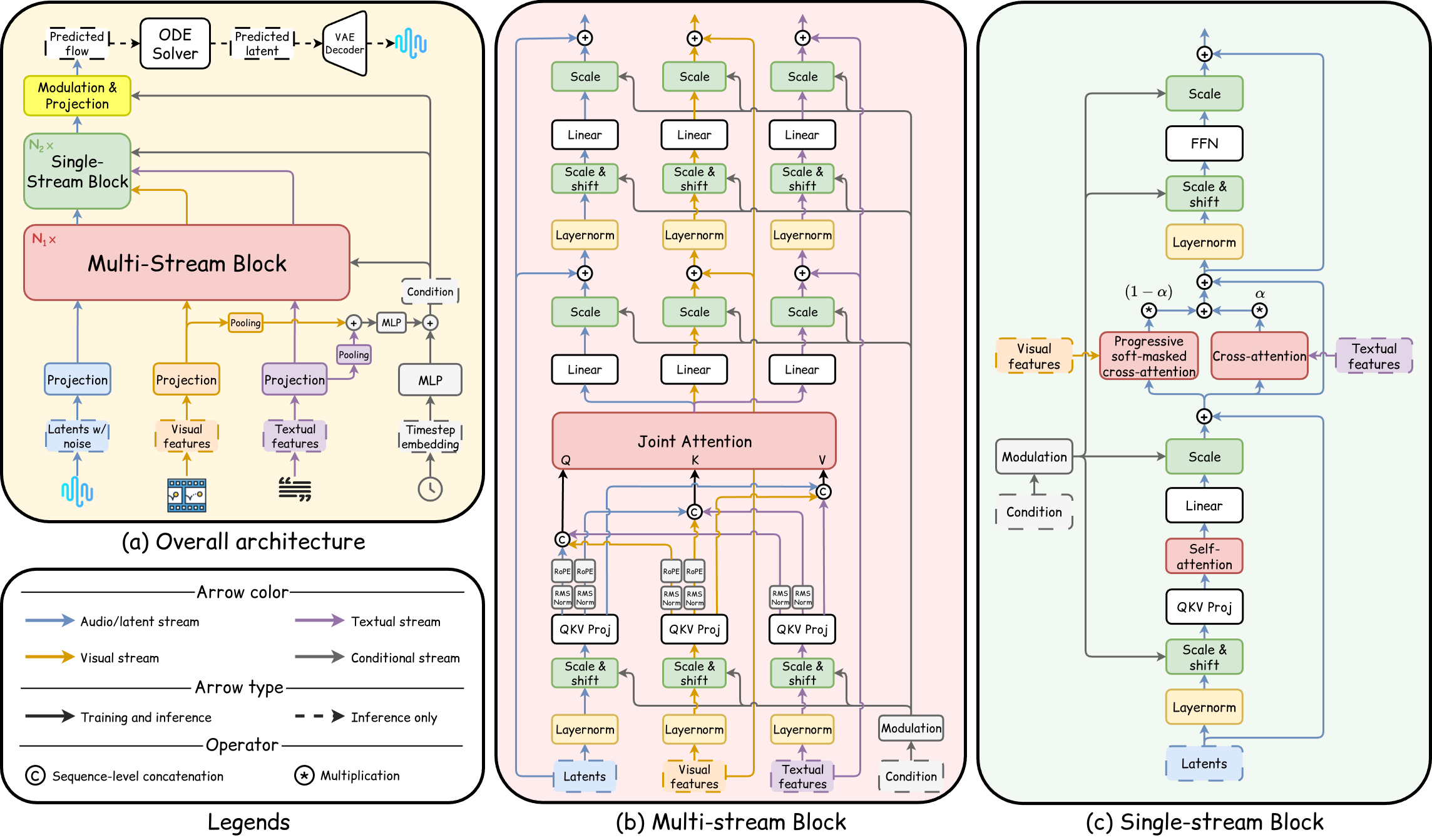
Figure 1: (a) The proposed Flowley framework consists of two core modules. (b) First, visual, textual, and audio latent representations are processed together through the multi-stream block. (c) Latent features are then passed into the single-stream block, where they undergo weighted cross-attention with the visual and textual streams to estimate the flow field. At inference time, we integrate this learned flow using standard ODE solvers to generate the compressed mel-spectrogram, which is subsequently decoded and vocoded into the final audio waveform.
Progressive Soft-masked Cross-Attention (PSCA)
To achieve precise audio-visual synchronization without relying on external pretrained modules or incurring additional computational costs, Flowley introduces the Progressive Soft-masked Cross-Attention (PSCA) module. PSCA employs a dynamic, differentiable soft mask that restricts the attention window on a frame-wise basis.
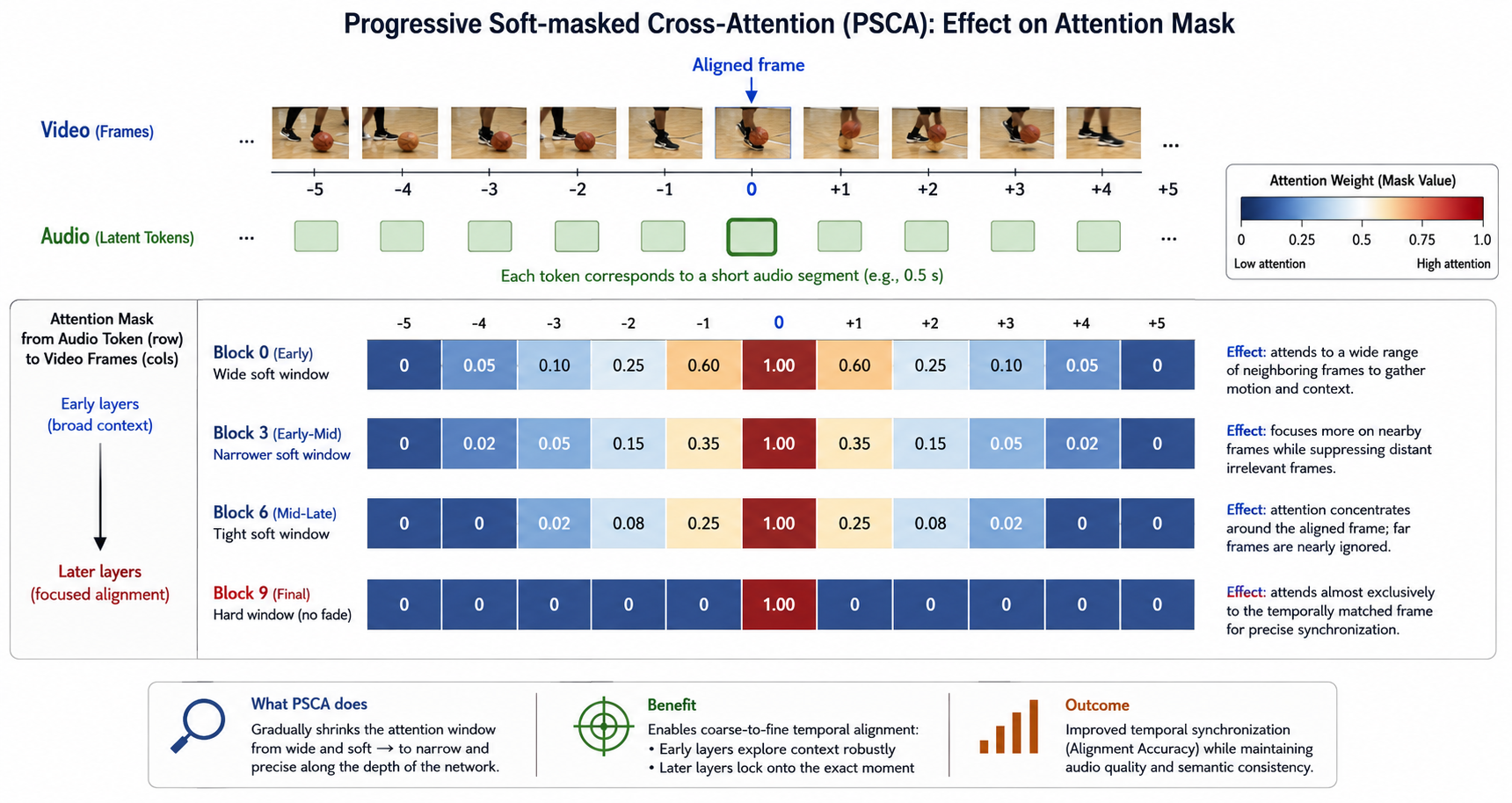
Figure 2: Dynamic attention masking in the PSCA module. As network depth increases, the soft attention window progressively shrinks from a wide context window in early blocks to a narrow, hard window in later blocks.
Empirically, this coarse-to-fine alignment strategy improves temporal synchronization (Alignment Accuracy) while preserving overall semantic consistency and high audio quality.